


Jeans are the most-owned garment on earth and one of the most resource-intensive things in your closet, which is an awkward combination.
The awkwardness is compounded by the fact that denim, done properly, is close to the ideal sustainable garment. Rigid cotton denim is a single material. It is repairable. It gets better with age rather than worse. It suits being worn for a decade, and there is an entire subculture devoted to doing exactly that. Nothing about the fabric is the problem.
The problem is everything done to it: the water it takes to grow, the chemistry used to make it blue, the industrial processes used to make new jeans look old, and the elastane increasingly woven through it that makes the whole thing unrecyclable.
So here is what actually determines whether a pair of jeans is a good or a terrible purchase, which certifications are worth looking for, and the single habit that does more than any of it.
Related reading: what is fast fashion, online thrift stores, circular economy, how we rate brands
Eco-Friendly Jeans At A Glance
- Cotton growing and your washing machine account for most of a pair of jeans' water footprint. The factory is not the whole story.
- Stretch denim is not recyclable. Elastane makes end-of-life recovery essentially impossible.
- Distressing is the worst part. The processes that make new jeans look worn have injured and killed workers.
- Look for rigid, 100% cotton, organic or recycled, with laser or ozone finishing rather than sandblasting.
- Wash them far less. This is the highest-impact thing you can do and it costs nothing.
- Secondhand denim is abundant and excellent, because good jeans survive their first owner easily.
The Water Problem, With Real Numbers
The figure you will see repeated is that a pair of jeans takes 2,000 gallons of water. That number gets thrown around loosely, so here is the better-sourced version.
Levi's has published lifecycle assessments of its own 501s, and the widely cited result is roughly 3,800 liters of water across the full life of a pair, which is about 1,000 gallons. The interesting part is the breakdown: the large majority comes from cotton cultivation, and a substantial further share, around a quarter, comes from consumer care, meaning you washing them at home.
Two conclusions follow, and both are actionable.
The fiber matters most. Conventional cotton is thirsty and pesticide-intensive. Organic cotton removes the synthetic inputs, and rain-fed cotton dramatically reduces irrigation demand. Recycled cotton avoids the growing stage almost entirely.
Your laundry habits are the second-biggest lever, and the only one you control after purchase. Which brings us to the most repeated piece of advice in denim circles, and one of the few that is actually true: stop washing your jeans so much. A former Levi's CEO made headlines by saying he had not washed a pair in over a year. That is further than most people will go, but the principle holds. Spot clean, air them, freeze them if you like the folklore, and wash them when they are actually dirty rather than on a schedule.
The Dye Problem
Denim is blue because of indigo, and indigo is where a lot of the environmental damage happens.
Natural indigo from plants was replaced over a century ago by synthetic indigo, which is derived from petroleum. Getting it to bond with cotton requires a chemical reduction process, historically using sodium hydrosulfite, and the resulting effluent is where the trouble lies. Untreated indigo wastewater is why rivers in some denim manufacturing regions have run visibly blue, most notoriously around the Chinese city that produces a large share of the world's jeans.
There is also the question of what is in the synthetic indigo itself. Production has historically involved aniline, a petroleum-derived compound with known toxicity, some of which remains in the finished fabric.
What better looks like: closed-loop dyeing systems that capture and reuse water, foam dyeing and other low-water techniques that use a fraction of conventional volumes, aniline-free indigo, and mills with proper effluent treatment. Some brands now publish which mill made their fabric, which is the transparency that makes any of this checkable.
The Distressing Problem, Which Is A Human One
This is the part of denim's story that deserves more attention than it gets.
Making new jeans look old is an industrial process, and for years the standard method was sandblasting: firing abrasive sand at the fabric under pressure to wear it down. Workers doing this inhaled silica dust, and the result was silicosis, an incurable and sometimes fatal lung disease. Cases were documented among young garment workers, and Turkey banned the practice in 2009. Many major brands subsequently pledged to eliminate it from their supply chains.
The practice has not entirely disappeared from unregulated workshops, which is the point: a pledge is only as good as the auditing behind it.
Other finishing processes carry their own risks. Potassium permanganate spraying, used to bleach and fade, is hazardous to handle. Stone washing with pumice consumes large volumes of water and energy and produces sludge. Hand scraping exposes workers to dust for long periods.
The good news is that the technology has moved on. Laser finishing can produce fading and distressing patterns digitally, with no chemicals and no manual abrasion. Ozone washing achieves fading with drastically less water. These systems exist, work well, and are now used by major manufacturers. A brand that has invested in them will usually tell you, because it was expensive.
The blunt version: heavily distressed jeans are the least sustainable and, historically, the most dangerous to make. A dark, undistressed pair is better on almost every axis, and it will fade into a pattern shaped by your own body, which is the thing distressing is imitating in the first place.
The Stretch Problem
Here is a change that happened quietly over the last twenty years and made denim substantially worse.
Most jeans sold today contain elastane, usually 1 to 3%, sometimes more. It makes them comfortable, forgiving on fit, and easier to size, which is why it took over.
It also makes them effectively unrecyclable. Textile recycling depends on separating fibers, and a few percent of elastane woven throughout cotton cannot practically be removed at scale. A 100% cotton pair can be mechanically recycled into new fiber or, at the end of everything, composted. A cotton-elastane blend goes to landfill.
Elastane also degrades. It breaks down with heat, washing, and time, which is why stretch jeans go baggy at the knee and never recover, and why they wear out years before rigid denim would.
The trade-off is real and worth naming honestly. Rigid denim is stiffer, takes a few weeks to break in, and is less forgiving about fit. In exchange it lasts far longer, molds to your body permanently rather than temporarily, can be repaired more easily, and can actually be recycled. For a garment you intend to keep, rigid wins clearly. For something you want comfortable immediately, stretch is the compromise, and it is a compromise.
What To Look For
Fiber: GOTS-certified organic cotton, recycled cotton content, or a blend of both. Regenerative organic cotton exists and remains rare.
Rigid, or minimal stretch. 100% cotton if you can. If you need stretch, look for the lowest percentage available, and check whether the stretch comes from an elastane alternative designed to be separable.
Finishing method. Laser and ozone rather than sandblasting, potassium permanganate, or heavy stone washing. Brands that use them say so.
Dye transparency. Closed-loop water systems, aniline-free indigo, named mills.
Certifications. GOTS for organic cotton and processing, OEKO-TEX Standard 100 for chemical safety in the finished fabric, Fair Trade certification for manufacturing conditions, and Bluesign for the chemistry across production. We explain what each does and does not cover in our OEKO-TEX guide and certifications page.
Repairability. Does the brand offer repairs? Some run free or low-cost mending programs, which tells you they expect the jeans to last long enough to need it.
Take-back or resale. A few denim brands operate circular models, including one European brand that leases jeans and takes them back to be remade, which is one of the more interesting experiments in the circular economy.
And the darker wash, undistressed. Better on every count, and it will age into something specific to you.
A Famous Example
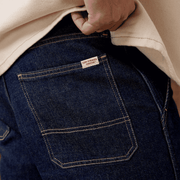
Levi's
What To Actually Do, In Order
Denim is the category where secondhand and repair beat new buying more decisively than almost anywhere else.
1. Wear what you own, longer. Jeans improve with age. This is the rare garment where the sustainable choice and the aesthetic choice are the same.
2. Wash them far less. Spot clean, air out, wash cold and inside out when actually needed, and never tumble dry. The dryer is what kills denim.
3. Repair before replacing. Most jeans die from a blown crotch seam or a knee hole, both of which are straightforward repairs. Visible mending has become a whole aesthetic, and a patched pair of jeans looks better than a new pair pretending to be old.
4. Buy secondhand. Denim is the single best secondhand category. It is durable, abundant, sized consistently enough to buy remotely if you know your measurements, and frequently barely worn. Our guide to online thrift stores covers the method.
5. When you buy new, buy rigid, dark, and organic, from a brand that will tell you where the fabric was made and what the finishing process was. Buy one pair rather than three.
Eco-Friendly Jeans FAQs
How much water does it take to make a pair of jeans? Levi's own lifecycle assessment puts it at roughly 3,800 liters, about 1,000 gallons, across the full life of a pair of 501s. Most of that is cotton growing, with around a quarter coming from consumer washing at home.
Are organic cotton jeans better? Yes on the farming impact, since conventional cotton is among the most pesticide-intensive crops. Look for GOTS certification, which covers processing and labor conditions as well as the growing.
Why is stretch denim a problem? Elastane makes jeans essentially impossible to recycle, because the fibers cannot be separated at scale. It also degrades over time, which is why stretch jeans bag out at the knee and wear out sooner than rigid denim.
Is distressed denim bad for the environment? Distressing is the most damaging stage of denim production, both environmentally and historically for workers. Sandblasting caused fatal lung disease among garment workers and was banned in Turkey in 2009. Laser and ozone finishing are far better alternatives.
How often should I wash my jeans? Much less than most people do. Spot clean between wears, air them out, and wash only when actually dirty. Washing is roughly a quarter of a pair's lifetime water footprint and the part you control.
What certifications should I look for in denim? GOTS for organic cotton and processing, OEKO-TEX Standard 100 for chemical safety in the finished fabric, Fair Trade for manufacturing conditions, and Bluesign for production chemistry.
Is secondhand denim a good idea? It is the best category for it. Jeans are built to last, the resale market is enormous, and a broken-in pair is more comfortable than a new one.
What is the most sustainable pair of jeans? The pair already in your closet, worn for another five years. After that, secondhand. After that, rigid organic cotton from a brand that discloses its mill and finishing process.
Can jeans be recycled? Rigid 100% cotton denim can be mechanically recycled into new fiber or used as insulation. Anything containing elastane generally cannot, which is one of the strongest arguments for buying rigid.
Final Thoughts
Denim is a case where the product is not the problem. A pair of rigid cotton jeans is one of the most durable, repairable, single-material garments ever made, designed originally for people doing hard physical work and capable of lasting decades.
What went wrong is everything the industry added: elastane for comfort, chemical and abrasive processes to make new things look old, and a production model that treats a garment built to last ten years as something to replace every eighteen months.
The way back is not complicated. Buy fewer, buy rigid, buy dark, buy organic where you can, buy secondhand where you can, wash them rarely, and mend them when they go. Your jeans will look better for it, which is the part the sustainability framing usually forgets to mention.
We rate brands whether or not we stock them. Our rating method is here, and every assessment separates sustainability from non-toxicity and social responsibility.
Editor's note: Published September 2026. We review brand ratings periodically and scores may change.



























