


You spend about a third of your life in direct, prolonged, full-body contact with your bed sheets. That's more sustained skin exposure than any garment you own, any chair you sit in, and any product in your bathroom cabinet.
Which makes it slightly odd that most of us choose bedding the way we choose a birthday card. Something in the right colour, roughly the right price, ideally soft, purchased in under four minutes.
The bedding aisle does not make this easier. Every set is "luxuriously soft" and "breathable" and "eco-friendly." Thread counts climb into numbers that stopped meaning anything years ago. Bamboo is marketed as though it were harvested and woven by hand in a peaceful grove. And somewhere in there sits a real question about what you actually want touching your face for eight hours a night.
So here's a straight guide to earth-friendly bedding: which fibres hold up to scrutiny, what the certifications actually certify, why thread count is mostly theatre, and what we make of some of the big names people ask us about.
Related reading: our bedding collection, sustainify your bedroom, how we rate brands, certifications explained
Earth-Friendly Bedding At A Glance
- The fibre matters more than the marketing. Organic cotton, linen, hemp and closed-loop lyocell are the four worth your money. Everything else needs a closer look.
- "Bamboo" usually means bamboo viscose, which is a chemically intensive process wearing a very green costume. Bamboo lyocell is the better version.
- GOTS and OEKO-TEX are not the same thing. One covers how it was grown and made, the other covers what's left in the finished fabric. You want to know which you're getting.
- Thread count above roughly 400 is mostly marketing. Weave and fibre quality decide how sheets feel.
- Longevity is the whole game. A set that survives ten years beats a "sustainable" set you replace in two, every time.
Why Bedding Is Worth Getting Right
Three reasons, and they compound.
Surface area and contact time. A queen set is several square metres of fabric pressed against your skin for a third of every day, while you're warm and perspiring, which is precisely when fabrics release whatever they've been finished with. If you're going to care about textile chemistry anywhere, the bed is the rational place to start.
Bedding is bought rarely and kept long. Unlike clothing, you're not replacing sheets seasonally. A good set stays in rotation for five to ten years, which means one careful decision pays out over thousands of nights. Few purchases have that ratio.
Volume. Bedding is heavy. A duvet cover uses several times the fabric of a T-shirt, so the material choice carries several times the footprint. Getting cotton right in your bedroom moves more than getting it right in your wardrobe.
The Fibres, Ranked By How Well They Hold Up
Organic cotton. The dependable answer. Conventional cotton is among the most pesticide-intensive crops grown, and organic certification removes synthetic pesticides and fertilisers from the equation while also, under GOTS, restricting the processing chemistry downstream. It breathes, it launders forever, it gets softer with age, and it's repairable and compostable at the end of its life. The trade-off is water use, which remains significant even organically grown, and price.
Linen. Flax needs little water, few inputs, and grows happily in cooler European climates. Linen is the most durable bedding fibre in common use and famously outlives its owners in some households. It's cool in summer, insulating in winter, and it looks better rumpled, which removes ironing from your life permanently. The trade-offs are cost and the initial texture, which is crisp bordering on scratchy for the first several washes before it turns into the softest thing you own.
Hemp. Similar profile to linen, slightly rougher at first, exceptionally durable, minimal pesticides and water. Still niche in bedding, usually blended, and worth trying if you like linen but want it tougher.
Lyocell, including bamboo lyocell. Made by dissolving wood or bamboo pulp in a non-toxic solvent that gets recovered and reused at around 99%, then spinning it back into fibre. Cool to the touch, highly absorbent, and the standout choice for hot sleepers. It's semi-synthetic rather than natural, but the closed-loop process makes it one of the cleaner manufactured fibres available. We wrote a full guide to lyocell if you want the detail.
Bamboo viscose. Here's where care is needed. Most bedding sold as "bamboo" is bamboo viscose, made by dissolving bamboo pulp using carbon disulfide, a solvent with a well-documented record of harming factory workers and waterways when handled in open systems. The plant is fast-growing and needs little water, which is the part the marketing tells you. The processing is the part it doesn't. Some producers now run closed-loop systems that recover their chemicals, which makes a large difference, but "bamboo" on a label tells you nothing about whether yours is one of them.
Conventional cotton. Not villainous, just unimproved. Heavy pesticide load, no restrictions on processing chemistry, no information about labour. It's the default, and the default is what we're trying to move away from.
Polyester and microfibre. Cheap, wrinkle-resistant, sheds microplastics with every wash, sleeps hot, and feels increasingly plasticky as it ages. This is the bedding to walk past.
What About Cozy Earth?
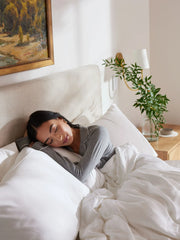

We get asked about Cozy Earth more than any other bedding brand, so let's deal with it directly rather than pretend the question isn't there.
We rated them. They landed as Average, and the interesting part is how uneven that score is underneath.
Non-toxicity: 10 out of 10. Full marks, and deserved. Their flagship textiles carry OEKO-TEX Standard 100 certification, meaning the finished fabric has been tested for formaldehyde, azo dyes, heavy metals and the rest, and the brand avoids caustic chemicals in fibre processing. If your reason for shopping is what's touching your skin, they perform well on that specific question.
Sustainability: 5 out of 10. The flagship products are bamboo viscose, and the brand states its fabric is made in a closed-loop process that recycles water and avoids releasing waste, which is meaningfully better than open-loop viscose. But a considerable share of the wider range still uses higher-impact materials: fossil-based synthetics in the stretchy clothing, nylon and acrylic blends in places, and towels made from a cotton and bamboo viscose mix where the cotton isn't identified as organic or certified. There's little public information on energy use, emissions tracking or renewable energy, production is global with bamboo textiles made in China and shipped worldwide, and there's no take-back or end-of-life programme.
Social responsibility: 4.5 out of 10. They say they work directly with farmers, processors, weavers and sewists rather than through middlemen, which if accurate is a good structure. The problem is verification: no published supplier code of conduct, no factory list, no disclosed audits or fair trade certifications. They do run a programme donating 1% of every purchase to a nonprofit the customer chooses, which is a real commitment.
So what does that add up to? A brand making comfortable, non-toxic products with a reasonable materials story and thin transparency behind it. Not greenwashing, and not a brand we'd warn anyone away from. Simply one that didn't clear the bar we set for stocking in our marketplace, which requires more than good intentions and a soft hand-feel.
That's the whole point of rating brands we don't sell. You can read the full Cozy Earth evaluation with every category broken out, and decide for yourself. We'd rather you had the information than our conclusion.
What The Labels Actually Certify
This is where most bedding shopping goes wrong, because two very different certifications get treated as interchangeable.
GOTS (Global Organic Textile Standard) is the demanding one. It covers the fibre being organically grown and the entire processing chain: restricted chemical inputs, wastewater treatment, and social criteria covering working conditions. A product labelled "organic" under GOTS must contain at least 95% certified organic fibre, while "made with organic" requires at least 70%. When you see GOTS, you're being told something about the farm, the mill and the people.
OEKO-TEX Standard 100 tests the finished textile for harmful substances. It's a useful, rigorous safety check, and it's the right certification to look for if chemical residues are your concern. But it says nothing about organic farming, nothing about water use, and nothing about labour conditions. A conventionally grown, conventionally processed sheet can carry OEKO-TEX certification perfectly legitimately.
Neither is better. They answer different questions. The mistake is reading OEKO-TEX as an all-purpose sustainability badge, which is exactly how it's often presented.
You can browse our OEKO-TEX certified range directly, and our certifications page explains the rest of the alphabet soup.
Watch for unbacked language. "Natural," "eco," "green," "pure" and "earth-friendly" are unregulated words that any brand may print on any product. They aren't lies exactly. They're just not claims about anything.
The Thread Count Myth
Thread count is the number of threads per square inch. More is better, up to a point, and that point arrives earlier than the packaging suggests.
Somewhere around 200 to 400, depending on weave, you've reached the practical ceiling for a single-ply cotton sheet. Beyond that, manufacturers often reach the higher numbers by counting each ply of a multi-ply thread separately, so a 250-count fabric made with four-ply yarn gets marketed as 1,000. The result isn't finer. It's often heavier, denser and less breathable than a well-made 300.
What actually determines how sheets feel:
- Fibre quality and staple length. Long-staple cotton makes smoother, stronger, longer-lasting fabric. This matters far more than the number.
- Weave. See below.
- Finishing. Some sheets feel wonderful in the shop because they've been treated with softeners that wash out within a month. If a set feels dramatically softer than its fibre and weave suggest it should, that's usually why.
Buy on fibre and weave. Treat thread count as a rough sanity check rather than a ranking.
Percale Or Sateen? (And Why It's The Question To Ask)
Two weaves account for most cotton bedding, and choosing correctly matters more than almost any other decision here.
Percale is a simple one-over-one-under weave. Matte finish, crisp hand, cool and breathable, and it makes that particular sound when you get into a freshly made bed. It's the hotel sheet feel. Best for hot sleepers and anyone who likes bedding to feel structured. It softens beautifully over years without ever becoming slippery.
Sateen puts more threads on the surface, producing a smooth, slightly lustrous fabric with a fluid drape. It feels softer immediately, sleeps a touch warmer, and drapes closer to the body. Best if you like a silky feel or run cold.
Neither is more sustainable. It's purely how you want to sleep, and it's the single best predictor of whether you'll like a set. If you've ever bought expensive sheets and quietly disliked them, there's a decent chance you bought the wrong weave rather than the wrong brand.
What We Look For Before Stocking Bedding
Our full rating criteria cover this properly, but for bedding specifically:
Certified fibre, not claimed fibre. GOTS for cotton, closed-loop processing for cellulosics, credible sourcing documentation throughout.
Processing transparency. Where was it milled, dyed and finished? Dyeing is where a good fibre most often gets undone, and low-impact dyes meeting OEKO-TEX or Bluesign criteria are what we want to see.
Labour, verified. A factory list, a code of conduct, third-party audits. Saying you treat people well is not the same as showing it.
Durability. We'd rather stock a set that lasts a decade than one that's compostable and threadbare by year two. Longevity is a sustainability metric, not a separate quality question.
Packaging. Plastic-free, ideally reusable. Bedding gets shipped in a lot of polybag by default.
End of life. Can it be composted, repurposed or returned? Cotton and linen become cleaning cloths, then compost. Polyester blends become landfill.
Rated Earth-Friendly Bedding Brands
These are the bedding brands in our marketplace, all evaluated before we'd stock them, none of them paying for placement.
ettitude
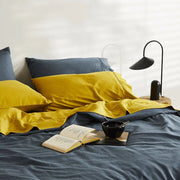


Price: Around $40 to $150 for most pieces
If you came here from a bamboo sheet search, ettitude is the version of that idea done properly. Their CleanBamboo fabric is bamboo lyocell, made through the closed-loop solvent process rather than conventional viscose, which addresses the exact concern that makes most bamboo bedding hard to recommend.
In practice it sleeps cool and feels silky rather than crisp, which puts it firmly in the sateen camp of preferences. For hot sleepers this is the collection to try first, since lyocell's moisture management is more noticeable in bedding than in any garment.
The range runs from the Signature Bamboo fitted sheet through to a CleanBamboo Hemp Linen+ pillowcase set that blends in hemp for more texture and durability. There's cot and toddler bedding too, which is where non-toxic certification arguably matters most.
Worth knowing: the highest price point in our bedding range, and the silky hand is divisive. If you're loyal to crisp percale, this will feel like a different category of bedding rather than an upgrade.
Organic Cotton Mart


Price: Around $15 to $55 for most pieces
The counterweight to everything expensive in this category. Organic Cotton Mart does GOTS-certified organic cotton bedding at prices that don't require a deep breath first, with a sateen sheet set starting under $50 and pillowcases from about $15.
They're also the brand here offering both weaves, so if you've read the percale-versus-sateen section and know which camp you're in, you can act on it. The percale set is the one for hot sleepers who want structure rather than silk.
We rate accessible pricing highly in this category for a straightforward reason: sustainable bedding that costs $400 a set is a recommendation most households can't act on, and a recommendation nobody can act on doesn't change anything.
Worth knowing: the finish is more practical than luxurious. These are good, honest, certified sheets rather than an indulgence, and they're priced accordingly.
Public Goods
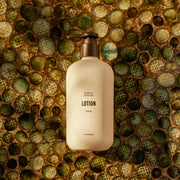
Price: Around $55 to $80
A smaller bedding presence with us, but the organic cotton duvet cover and cover and sheet set are worth knowing about if you want plain organic cotton in undecorated white with no branding anywhere on it. The whole Public Goods approach is stripped-back and unfussy, which suits bedding well.
Worth knowing: limited range and limited colours. This is a duvet cover solution rather than a whole-bed solution.
Public Goods has been rated by Shifting Gaia. See the full rating.
Reistor (for what you wear in the bed)


Price: $$
Not bedding, but adjacent enough to belong here. Reistor's pyjama sets are 100% TENCEL lyocell, which makes them the sleepwear equivalent of everything good about lyocell sheets: cool, breathable, moisture-managing, and pleasant against skin. All their fabrics use low-impact dyes meeting OEKO-TEX Standard 100 and Bluesign criteria, so the finishing chemistry holds up alongside the fibre.
If you sleep hot and have been fixing it by buying better sheets, sleepwear is the other half of that equation and the cheaper half to change. Browse the rest in our sleepwear and loungewear collection.
Making Bedding Last (The Part That Matters Most)
Nothing on this page matters as much as how long your sheets survive.
Wash cooler and less often. Weekly for sheets is plenty for most people; hot washes are hard on fibres and unnecessary for anything except illness. Cold or warm with a good detergent handles it.
Skip fabric softener. It coats fibres, reduces absorbency and breathability, and builds up over time. Cotton and linen soften naturally with washing anyway.
Go easy on the dryer. Heat is what ages bedding fastest. Line dry where you can, or tumble low and remove slightly damp.
Rotate two sets. Alternating gives fibres recovery time between uses and roughly doubles how long both last, which is the least intuitive and most effective tip here.
Repair the small things. A split seam or a torn corner elastic is a twenty-minute fix, not grounds for replacement.
Retire them properly. Worn cotton and linen make excellent cleaning cloths, then compost. Textile recycling takes what's left. Bedding is one of the easiest categories to keep out of landfill because the fibres, if you bought well, are compostable.
Our laundry collection has low-tox detergents if you want the whole routine consistent.
Earth-Friendly Bedding FAQs
What's the most sustainable bedding material? Organic cotton and linen for natural fibres, closed-loop lyocell for manufactured ones. Linen edges ahead on water and pesticide use and lasts longest; organic cotton is the most versatile and widely available. Any of the three, kept for a decade, comfortably beats the alternatives.
Is bamboo bedding eco-friendly? It depends entirely on processing, which the word "bamboo" doesn't tell you. Bamboo lyocell uses a closed-loop system and is a strong choice. Bamboo viscose uses carbon disulfide and is only as good as the mill's containment. If the label just says bamboo, ask which one it is.
Is GOTS or OEKO-TEX better? They cover different ground. GOTS covers organic farming, processing chemistry and labour conditions. OEKO-TEX Standard 100 tests the finished fabric for harmful substances. For a full picture you want GOTS; for chemical safety specifically, OEKO-TEX does the job.
Does thread count matter? Up to about 400, somewhat. Beyond that it's mostly a marketing number inflated by counting plies. Fibre quality and weave decide how sheets actually feel.
Percale or sateen? Percale if you sleep hot or like crisp, matte, hotel-style bedding. Sateen if you like a silky, smooth, slightly warmer feel. Same sustainability, completely different experience.
Is Cozy Earth sustainable? We rated them as Average: full marks on non-toxicity, middling on sustainability, weaker on social responsibility transparency. The full breakdown is on their rating page, and it's worth reading before you spend that much on sheets.
How often should I replace my sheets? Well-made cotton or linen bedding should last five to ten years, longer for linen. If you're replacing sets every couple of years, the fibre quality or the washing routine is the thing to change, not the brand.
Are organic sheets worth the money? Per year of use, usually yes, since organic cotton is typically better-constructed and outlasts cheap conventional sets. Work out cost per year rather than cost per set and the maths tends to look different.
Final Thoughts On Earth-Friendly Bedding
The bedding category is unusually full of confident language and unusually short on verifiable claims, which is why we keep coming back to the same two questions: what is it made of, and who can prove it?
Get those right and the rest sorts itself out. Certified organic cotton, linen, or a closed-loop lyocell. A weave that matches how you actually sleep rather than how the packaging photographs. A brand willing to tell you where things were made. Then wash it gently, keep it for years, and stop thinking about it.
And if the brand you were considering scored average with us, that's information rather than a verdict. We publish ratings for brands we don't sell precisely so you can weigh it up yourself. Comfortable and certified non-toxic is worth something. It just isn't the same as the whole picture, and you deserve to know which one you're buying.
Shop rated bedding in the Shifting Gaia marketplace. Every brand independently evaluated, no paid placements, ever.
Editor's note: Published August 2026. Brand ratings are reviewed periodically and scores may change as brands update their practices.




























