


Underwear is the only garment you wear every single day, for roughly sixteen hours, pressed directly against some of the thinnest and most absorbent skin on your body, often while warm and slightly damp.
It is also, for most people, the garment they think about least. We agonize over the ethics of a $90 sweater and then buy a five-pack of polyester briefs at the checkout without reading a single word on the label.
There is something a bit funny about that, and also something worth fixing. Not because your underwear is secretly poisoning you (it almost certainly is not), but because this is the one category where the fabric choice has an actual, noticeable, day-to-day effect on how you feel. People who switch to breathable natural fibers tend to describe the difference in terms of comfort rather than virtue, which is usually a sign that a change is worth making.
So here is what is actually in most underwear, what organic cotton does and does not solve, and which brands hold up when you look closely.
Related reading: our intimates collection, how we rate brands, certifications explained, fashion & apparel
Organic Cotton Underwear At A Glance
- Most underwear is plastic. Polyester, nylon, and microfiber dominate the category, including plenty of pairs marketed as breathable.
- The gusset is the part that matters most. That small panel sits against the most sensitive skin you have. Check what it is made of before anything else.
- "100% cotton underwear" almost never means 100%. Nearly all of it contains 5 to 20% elastane, because pure cotton underwear does not hold its shape. That is a reasonable trade, but the label should be honest about it.
- GOTS covers the growing and the making. OEKO-TEX covers what is left in the fabric. Different questions, both useful.
- Underwear is the shortest-lived garment you own, which makes durability and end-of-life worth thinking about more than in other categories, not less.
Why Underwear Is The Garment Worth Getting Right
Three things make this category different from the rest of your wardrobe.
Contact time and skin type. Sixteen-ish hours a day, against skin that is thinner and more permeable than the skin on your arms. The vulvar area in particular absorbs more readily than most external skin. This is not a reason to panic, but it is a reason to apply more scrutiny here than to your outerwear.
Heat and moisture. Textiles release finishing chemicals more readily when warm and damp, which describes the inside of your underwear on any given afternoon. Whatever is in the fabric has favorable conditions for coming out of it.
Breathability affects actual comfort. Synthetic fabrics trap heat and moisture against the skin. Clinicians have long recommended breathable natural fibers for people prone to irritation, yeast infections, or general discomfort, though it is worth being straight with you: the clinical evidence linking underwear fabric to infection rates is thinner and more mixed than most wellness marketing suggests. What is better established is simple comfort. Cotton breathes, moves moisture, and stays cooler. Most people can feel the difference within a week.
What Conventional Underwear Is Actually Made Of
Walk through the composition label of a typical multipack and you will find some combination of:
Polyester, nylon, or microfiber. Petroleum-derived plastics, spun into thread. They are cheap, hold color well, dry fast, and hold their shape. They also trap heat, hold odor over time (which is why synthetic underwear starts smelling permanently musty), and shed microplastics into wastewater with every wash.
Elastane, spandex, or Lycra. All the same thing, all synthetic, all present in nearly every pair of underwear made. More on this below, because it is the one you cannot fully escape.
Conventional cotton. Not bad, exactly, but grown as one of the most pesticide-intensive crops in the world and processed with no restrictions on the chemistry involved.
Dyes and finishes. Where the more legitimate concerns sit. Azo dyes, formaldehyde-based wrinkle finishes, antimicrobial treatments, and softeners are all used across the industry. Certification is the practical way to know whether yours are.
PFAS, in some cases. Worth knowing about because it moved the whole category: a major period underwear brand faced a class action over its marketing claims, settled in 2023, following independent testing that reported PFAS in products marketed as free of harmful chemicals. The settlement did not establish that the products were unsafe, and the brand denied wrongdoing. What it did do was push the category toward third-party testing and clearer disclosure, which is a good outcome regardless of the specifics.
The Gusset Is The Thing To Check First
If you take one practical tip from this page, make it this one.
The gusset is the small reinforced panel at the crotch. It is the part of the garment in contact with the most sensitive skin, and it is also the part that manufacturers most often treat as an afterthought. A pair of underwear can be advertised as cotton while the outer fabric is 90% polyester and only the gusset is cotton, or the reverse: a cotton outer with a synthetic gusset where it matters most.
What you want is a gusset made of 100% cotton, ideally certified organic, with no synthetic lining underneath it. Some brands build this deliberately and say so. Most say nothing, which usually tells you something.
This single detail is a better predictor of how underwear feels to wear than the price, the brand, or the marketing language on the front of the packet.
About That "100% Cotton" Claim
Here is the honest version of something the sustainable underwear world tends to skate over.
Nearly all underwear contains elastane, typically 5 to 20%. That is what allows it to stretch on, hold its shape through the day, and recover after washing. Truly 100% cotton underwear exists, but it tends to bag out, lose its waistband shape, and need replacing sooner, which is why almost nobody makes it and fewer people rebuy it.
So when you see "100% organic cotton underwear" in a headline, it usually means one of two things: the gusset is 100% organic cotton, or the cotton content is 100% organic even though cotton is only 80% of the fabric. Both are reasonable. Neither is the same as a garment made entirely from cotton.
Is the elastane a problem? Modestly. It is a synthetic that makes the garment non-compostable and hard to recycle, and it sheds a small amount of microplastic. Set against that, it substantially extends how long the garment stays wearable, and a pair that lasts three years beats a compostable pair that sags after four months.
Our position: 80 to 95% organic cotton with a 100% organic cotton gusset is a sensible design, and a brand that states the split plainly is being more honest with you than one that hides behind a rounded-up headline.
GOTS, OEKO-TEX, And What They Each Cover
Two certifications dominate this category and they answer different questions.
GOTS (Global Organic Textile Standard) is the thorough one. It requires the cotton to be organically grown and it governs the entire processing chain: restricted chemical inputs, wastewater treatment, and social criteria covering working conditions. A garment labeled organic under GOTS contains at least 95% certified organic fiber; "made with organic" requires at least 70%. When you see GOTS, you are being told something about the farm, the mill, and the people.
OEKO-TEX Standard 100 tests the finished textile for harmful substances: formaldehyde, azo dyes, heavy metals, and a long list of others. It is a rigorous safety check on the final product. It says nothing about organic farming, water use, or labor conditions.
For underwear specifically, you want both if you can get them. GOTS for how it was made, OEKO-TEX for what is left in it. Several brands hold both, and it is a reasonable filter to shop by. Our certifications page covers the rest of the acronyms.
Unregulated words to treat as decoration: natural, clean, pure, chemical-free, non-toxic, eco. Any brand can print any of these on any product. They are not lies so much as non-statements.
Rated Underwear Brands
These are the brands in our marketplace, all evaluated before we would stock them, none of them paying for placement. Worth knowing upfront that they split into three different jobs: everyday underwear, period underwear, and intimates for bodies recovering from surgery. They are not really competitors with each other.
PantyPromise
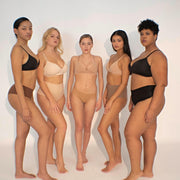


Price: Around $22 to $26 per pair
If you are here for everyday organic cotton underwear rather than period care, this is the one on our shelf built for that job, and it is built thoughtfully.
The construction answers the gusset question directly: the patented liner is 100% GOTS-certified organic cotton, so nothing synthetic sits against sensitive skin, while the outer fabric is an 80% organic cotton and 20% elastane blend milled in Italy for four-way stretch. That is exactly the split we described above, and we rate them well for stating it plainly rather than rounding it up to "100% organic cotton" the way much of the category does.
The cotton carries both GOTS and OEKO-TEX Standard 100 certification. Sizing runs XS to 4X across nine sizes, which is a wider range than most sustainable underwear brands manage, and the styles are seamless, so they solve the visible-panty-line problem that sends a lot of people back to synthetics. The brand was co-founded with input from a gynecologist, which shows in the design priorities.
Packaging deserves a mention because it is unusually good: no polybags anywhere, each pair arriving in a paper box made from 80% post-consumer recycled material, with FSC-certified paper for the bands and tags. Underwear is one of the worst categories for single-use plastic and they have simply removed it.
Worth knowing, honestly: our evaluation found no evidence of renewable energy use or carbon offsetting in production, and the supply chain is long, with cotton milled in Italy, garments made in Sri Lanka, and sales mostly in North America. The brand has also acknowledged that underwear cannot realistically be resold, and has designed for biodegradability instead, which is a sensible response to a real constraint.
Saalt


Price: $$
Saalt sits in reusable period and body care, and their underwear uses TENCEL lyocell as the main fabric, which is a smart choice for this application. Lyocell is made from wood pulp in a closed-loop process, it manages moisture better than cotton, and it stays cool, all of which matter more in period underwear than in anything else you own.
Their range extends well beyond underwear into cups and discs, so this is the brand to look at if you are trying to move your whole period routine away from disposables rather than swapping one product.
Worth knowing: reusable period products have a real upfront cost and a learning curve. Most people need a cycle or two to work out their own absorbency needs before the system starts feeling easier than what it replaced.
The Period Company

Price: $
The accessible end of period underwear, and the reason we stock them. Reusable period products are frequently priced in a way that makes them a middle-class purchase, which rather undercuts the environmental argument, since the people buying the most disposables are often the people who can least afford a $40 pair of underwear.
The Period Company solves that with straightforward pricing and high absorbency, with pairs rated to hold up to nine tampons' worth of flow, plus reusable pads and a carry pouch for changes away from home. There is an organic cotton bikini style in the range, which is the one we would point you toward.
Worth knowing: the range includes microfiber styles alongside the organic cotton ones, so check the specific product composition rather than assuming across the whole line. Microfiber performs well and costs less, but it is a synthetic, and if you came to this article for natural fibers that distinction matters to you.
Everviolet

Price: -$
A small but meaningful part of our range: intimates designed for bodies that have been through breast surgery, with construction that accounts for scarring, sensitivity, and changed shape. This is a category the mainstream lingerie industry has served poorly for a long time.
If you or someone you are shopping for is in that situation, this is worth knowing exists, and it is the sort of brand we are glad to carry regardless of how many keywords it ranks for.
Worth knowing: a very focused range with us, currently two products.
Also in the range: Tampon Tribe, covering organic cotton period care, which pairs naturally with any of the reusable options above. Browse everything together in our intimates and underwear collection.
How To Actually Choose A Pair
Start with the gusset. Covered above, still the most useful filter.
Then the outer fabric composition. Look for the split stated explicitly. A brand that writes "80% organic cotton, 20% elastane" is telling you the truth. A brand that writes "organic cotton" with no percentages may be telling you the truth too, but you cannot know.
Then the cut, honestly. The most sustainable underwear is the pair you keep wearing, and the pair you keep wearing is the one that does not ride up, dig in, or need adjusting. If you know you only ever reach for high-waisted briefs, buy those, not the style that photographs better.
Seamless or seamed. Seamless disappears under fitted clothing and suits most people. Seamed styles often last longer and breathe slightly better. Neither is more sustainable.
Buy singles before packs. Underwear fit is unusually personal and unusually variable between brands. One pair first, then the multipack once you know. This is also the cheapest way to avoid the most common form of sustainable-shopping waste, which is a five-pack of something that turns out not to fit.
Check the size range before you fall in love. A brand that stops at L is not really solving this problem for everyone.
Care, Longevity, And When To Let Go
Underwear has the shortest life of anything in your wardrobe, so getting more out of each pair does more here than almost anywhere else.
Wash cool, on gentle, in a mesh bag. Heat and agitation destroy elastane, which is what fails first in nearly every pair. A mesh bag stops the tangling that stretches waistbands out.
Skip fabric softener. It coats cotton, reduces absorbency and breathability, and degrades elastic over time.
Air dry. The dryer is what kills the stretch. Underwear dries in a couple of hours on a rack and the pairs will last noticeably longer.
Replace when the elastic goes, not on a schedule. You will see advice to replace all underwear annually. For a well-made pair, cared for as above, two to three years is realistic. The signals to watch are a waistband that no longer recovers, thinning fabric, and persistent odor that survives washing, which is usually synthetics reaching the end of their useful life.
End of life is the hard part. Underwear cannot be donated or resold, and that is not squeamishness, it is a real constraint the industry has to design around. Cotton-rich pairs can be cut up as cleaning rags and eventually composted once elastic waistbands are removed. Some textile recycling programs accept them as fiber feedstock. Polyester pairs have no good ending, which is one more argument for cotton at the point of purchase.
Organic Cotton Underwear FAQs
Is organic cotton underwear worth the money? Per pair, it costs more. Per year, the gap narrows, because organic cotton underwear from a decent brand tends to outlast a cheap synthetic multipack. The stronger argument is comfort: breathable natural fiber against skin for sixteen hours a day feels different, and that is the part people notice first.
Is there truly 100% cotton underwear? It exists, but it is rare, and it loses its shape faster because cotton has no recovery. Most "100% cotton" underwear means a 100% cotton gusset or 100% organic cotton content within a cotton-elastane blend. Neither is dishonest, but they are different claims and worth reading carefully.
Does synthetic underwear cause yeast infections? Breathable natural fibers are commonly recommended by clinicians for people prone to irritation, and the reasoning about heat and moisture is sound. That said, the direct clinical evidence linking fabric to infection rates is more limited than wellness marketing implies. If you are dealing with recurrent infections, that is a conversation for a doctor rather than a shopping decision.
What does GOTS certified organic cotton underwear actually mean? That the cotton was grown organically and that the processing met standards for chemical inputs, wastewater, and working conditions. It is the most comprehensive certification in this category.
Is period underwear safe? Broadly, yes, and it has become notably better documented since the PFAS controversy pushed brands toward third-party testing. Look for OEKO-TEX certification and explicit statements about PFAS, and treat vague reassurance as the non-statement it is.
Is bamboo underwear a good option? It depends on the processing, which the word bamboo does not tell you. Bamboo lyocell uses a closed-loop system and is a solid choice. Bamboo viscose is chemically intensive. If the label just says bamboo, it is usually the latter.
How many pairs do I actually need? Fewer than most people own. Somewhere between ten and fourteen covers a normal laundry cycle with margin. Buying quality in that quantity beats owning thirty mediocre pairs, and it makes the cost per pair easier to justify.
What about hypoallergenic underwear? Undyed or lightly dyed organic cotton with an OEKO-TEX certification is the practical version of this. There is no formal hypoallergenic standard for textiles, so what you are really looking for is fewer dyes, no antimicrobial or wrinkle-resistant finishes, and certification that the finished fabric has been tested.
Final Thoughts
Underwear is a small purchase that you make dozens of times over a lifetime, which is exactly the kind of decision worth getting right once and then not thinking about again.
The rule of thumb is short: check the gusset, look for a stated fiber split rather than a rounded-up headline, prefer GOTS and OEKO-TEX over adjectives, and buy the cut you already know you like. Then wash it cool, dry it on a rack, and get three years out of it instead of one.
And if the brand you are looking at will not tell you what percentage of the fabric is what, that is the answer to your question.
Shop rated organic cotton and reusable intimates in the Shifting Gaia marketplace. Every brand independently evaluated, no paid placements, ever.
Editor's note: Published August 2026. We update our guides as brands reformulate and certifications change.




























