


On 27 September 2026, a large number of product labels become illegal in Europe.
From that date, the EU's Empowering Consumers for the Green Transition Directive takes effect across all twenty-seven member states, with no transition period. Among the practices it bans outright: describing a product as carbon neutral, climate neutral, or carbon positive when that claim rests on offsetting rather than on emissions actually reduced within the product's own value chain. It also bans generic environmental claims such as "eco-friendly" or "sustainable" without recognized proof, and self-invented green badges that look like certifications but are not. Penalties run to 4% of annual turnover.
The rule applies to anyone marketing to EU consumers regardless of where the company is based, and fashion has been flagged as the highest-risk sector.
If you are shopping in the US, this still matters to you, because brands do not usually maintain two sets of packaging. What happens in Europe this month will quietly reshape what claims you see everywhere.
So this is a good moment to explain what these terms actually mean, why offsetting fell out of favor, and how to tell a serious climate claim from a purchased one.
Related reading: certifications explained, how we rate brands, what is regenerative agriculture, circular economy
Carbon Claims At A Glance
- Carbon neutral has historically meant emissions were measured and then cancelled out, often mostly by buying offsets.
- Net zero is a much higher bar: deep absolute cuts across the whole value chain, with only small residual emissions neutralized.
- The scopes decide everything. A claim that excludes Scope 3 is usually excluding most of the footprint.
- Offsetting has a credibility problem, based on real evidence about whether credits represent real reductions.
- From 27 September 2026, offset-based neutrality claims are banned in the EU.
- Planting trees is not the same as offsetting, and neither is the same as reducing.
The Terms, Ranked By How Much They Require
Carbon neutral traditionally means a company measured a footprint and balanced it to zero. Crucially, that balancing could be achieved almost entirely by purchasing credits rather than by changing anything about the operation. It is the least demanding of these terms and the reason regulators have targeted it.
Climate neutral is generally used interchangeably with carbon neutral, sometimes with a wider set of greenhouse gases included.
Net zero is a substantially stronger claim when used properly. Under the leading corporate standard, it requires deep absolute emissions reductions across the value chain, commonly on the order of 90%, with only the small residual neutralized through permanent removals. A company cannot buy its way to net zero. Many companies nonetheless use the phrase loosely, which is part of the problem.
Carbon negative or climate positive claims to remove more than is emitted. A strong claim if substantiated, and frequently offset-dependent in practice.
Carbon reduced or lower carbon is the most modest and often the most honest, because it describes something the company actually did.
The useful question for any of these: did they reduce, or did they pay someone else to have reduced?
Scope 1, 2 And 3, And Why It Matters
This is the technical bit that decides whether a claim means anything, and it takes two minutes to understand.
Scope 1 is direct emissions from things a company owns and controls. Its factories, its vehicles, its boilers.
Scope 2 is indirect emissions from purchased energy. The electricity powering the building.
Scope 3 is everything else across the value chain. Raw materials, suppliers, transport, packaging, how customers use the product, and what happens when they throw it away.
For a consumer goods brand, Scope 3 is typically the overwhelming majority of total emissions, frequently 80% or more. A clothing brand's own offices and shops are a rounding error next to the cotton farming, the dyeing, the shipping, and the washing machine you run at home.
Which means the single most useful question to ask of any climate claim is: does it include Scope 3? A company that has gone carbon neutral on Scopes 1 and 2 has neutralized the small part and left the large part untouched. That claim is not false. It is just much less than it sounds.
How Offsetting Works, And Where It Goes Wrong
An offset is a credit representing one metric ton of greenhouse gas either avoided or removed somewhere else. A company emits a ton, buys a credit, and calls that ton cancelled.
For that to be true, four things must hold, and each is a point of failure.
Additionality. The reduction must not have happened anyway. If a forest was never going to be logged, paying to protect it changes nothing while generating credits. This is the hardest thing to prove because it requires knowing what would have happened in a world that does not exist.
Permanence. The carbon must stay stored. Forests burn, are logged later, or die in drought. A ton released today is permanent in the atmosphere. A ton stored in a tree is conditional.
Accurate baselines. Credits are calculated against a projection of expected emissions. Optimistic baselines generate more credits for the same activity, and the incentive runs entirely one way.
No leakage. Protecting one forest should not simply move the logging next door.
What the evidence has shown. Investigations and peer-reviewed analysis of forest carbon projects have repeatedly found that a large share of credits did not represent real, additional reductions, with baseline inflation the recurring problem. A 2023 analysis published in Science examined a set of forest conservation projects and found most had not reduced deforestation to anything like the extent claimed. Reporting in the same year on one of the largest certifiers prompted significant industry upheaval, and the certifier disputed the specific figures involved. Separate research has found some categories of credit, including certain clean cookstove projects, to be over-credited by roughly an order of magnitude.
The fair counterpoint. Not all credits are equal, and this matters. Direct air capture with geological storage, some biochar, and well-verified renewable projects in markets where the finance is truly decisive are different propositions from cheap avoided-deforestation credits. The market's problem has been that all of these traded as if interchangeable, and the cheapest and weakest dominated because they were the cheapest.
The structural problem with offsetting as a concept is more fundamental than any individual project. Offsetting permits an emission to continue in exchange for a reduction elsewhere. Even where the reduction is real, the atmosphere ends up in the same place rather than a better one, and the money funds continuation rather than transition.
What Is Changing In The Rules
The EU, from 27 September 2026. As described above, offset-based product neutrality claims become a prohibited commercial practice, alongside generic environmental claims and self-made eco-labels. There is no case-by-case balancing test. The claim is either substantiated within the product's own value chain or it is not permitted.
Notably, the directive does not ban companies from funding climate projects, and it does not ban corporate-level climate communication. It bans presenting a product as neutral on the strength of purchased credits. Companies can still say what they fund, in specific terms, with the numbers attached.
California, since 2024. State law now requires companies making net zero or carbon neutral claims in California to publicly disclose how those claims were determined, and requires those marketing or using offsets to disclose project details. It is a disclosure regime rather than a ban, and it applies to a very large market.
The FTC's Green Guides, which govern environmental marketing claims in the US, have been under review for some time. Whatever emerges is likely to reflect the same direction of travel.
What this means in practice: the era of a small green badge saying "carbon neutral" with nothing behind it is ending, and brands that have done real work will start publishing numbers instead of labels. That is a considerable improvement for anyone trying to shop carefully.
Tree Planting Is Not Offsetting, And Neither Is Reducing
Three different things that get muddled constantly, including by brands acting in good faith.
Planting trees is a contribution to a good cause. Trees are excellent, reforestation is valuable, and a brand funding it is doing something worthwhile. But a newly planted tree stores very little carbon for years, may not survive, and is not a verified offset unless it goes through a certification and monitoring process. Most tree-planting programs are philanthropy rather than accounting, and the honest ones say so.
Buying offsets is an accounting transaction with all the caveats above.
Reducing emissions means the company burns less, ships less, wastes less, or redesigns something. It is the only one of the three that changes the company's own footprint, and it is the hardest and least marketable.
How we weigh these: reduction first, always. Contribution programs are a positive signal about values and are not a substitute. Offsets, we treat as the weakest of the three and increasingly as a flag to look more closely rather than less.
How To Read A Climate Claim In Sixty Seconds
Look for a number. "Carbon neutral" is a label. "We measured 1,200 metric tons, cut 18% in two years, and here is the report" is a claim. The second one is what compliant marketing will look like from now on.
Check whether Scope 3 is included. If it is not mentioned, assume it is not included.
Ask reduce or offset. If the answer is only offset, treat it as a payment rather than a change.
Look for third-party validation of targets, such as a validated science-based reduction pathway. Self-declared targets with no plan and no verification are, under the new EU rules, specifically prohibited.
Distrust the badge you have never seen before. Self-created logos designed to look like certifications are now banned in the EU and were always a bad sign.
And weight packaging claims lightly. Carbon-neutral packaging on a high-footprint product is a small true statement standing in front of a large unexamined one.
Where Our Brands Actually Sit
We would rather show you the range than pick the flattering examples, so here is an honest spread from our own ratings.
Nomadix holds climate certification covering their measured footprint, is structured as a Social Purpose Corporation so environmental goals sit in the legal structure rather than the marketing, and publishes annual sustainability reports. They are the strongest carbon story in our range. Our evaluation is also clear that their products are recycled synthetics that shed microplastics and that there is no take-back program, which is a good illustration that a strong carbon claim is not a complete environmental picture.


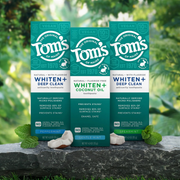
Tom's of Maine, which we rate but do not stock, is a useful example of what scale buys. Because they are owned by a large parent company, they publish third-party-verified emissions data and operate under externally approved science-based reduction targets. That is more transparency than almost any small brand can afford, and it sits alongside other issues in their rating including palm oil and SLS. Good on carbon, mixed overall.


IDUN Minerals scores a perfect 10 with us on non-toxicity and 5.9 on sustainability, and the gap is largely this: they have done real packaging work and moved manufacturing into Europe to cut transport emissions, but they have not published comprehensive carbon reporting, made renewable energy commitments, or set greenhouse gas targets. Excellent on chemistry, quiet on carbon.


PantyPromise is a similar shape. Strong certifications on materials and a strong packaging story, and our evaluation found no evidence of renewable energy use or emissions accounting, with a long supply chain from Italian mills to Sri Lankan manufacturing.



Tentree and Friendsheep both run tree-planting programs, which we count as contribution rather than as carbon accounting, exactly as described above.



The honest summary: most small brands, including most of ours, have not done formal carbon accounting, because it is expensive and complicated. That is a real limitation and we would rather report it than let a few good examples imply the whole shelf. When a brand does publish numbers, it shows up in their rating.
You can read our full rating method here, and every brand assessment on our site breaks out sustainability separately from non-toxicity and social responsibility for exactly this reason.
Carbon Claim FAQs
What does carbon neutral actually mean? Historically, that a company measured its emissions and balanced them to zero, often largely by buying offsets rather than reducing. From 27 September 2026, product-level claims of this kind based on offsetting are prohibited in the EU.
What is the difference between carbon neutral and net zero? Carbon neutral can be achieved by offsetting. Net zero, properly defined, requires deep absolute reductions across the entire value chain, usually around 90%, with only residual emissions neutralized. Net zero is far more demanding, though the term is often used loosely.
Are carbon offsets a scam? Not inherently, but the voluntary market has had serious quality problems. Analysis of forest conservation credits has repeatedly found large shares that did not represent real additional reductions. Some credit types, particularly engineered removals with durable storage, are much more robust than cheap avoided-deforestation credits.
What are Scope 1, 2 and 3 emissions? Scope 1 is direct emissions from what a company owns. Scope 2 is purchased energy. Scope 3 is the entire rest of the value chain, which for consumer brands is usually most of the total. Claims that omit Scope 3 omit most of the footprint.
Is planting trees the same as carbon offsetting? No. Tree planting is generally a contribution rather than a verified offset, since credits require certification, monitoring, and proof of additionality and permanence. Both can be worthwhile. Neither is the same as reducing emissions.
Is "carbon neutral" being banned? In the EU, product claims relying on offsetting outside the value chain are prohibited from 27 September 2026. It is not a blanket ban on the words, but the substantiation bar is high enough that few product-level claims will survive. California requires disclosure rather than prohibition.
What should I look for instead of a carbon neutral label? Specific measured numbers, an explicit statement about which scopes are covered, independently validated reduction targets, and evidence of reductions actually achieved rather than purchased.
Does carbon neutral mean the product is sustainable overall? No. Carbon is one impact among several. A carbon neutral product can still involve microplastics, poor labor conditions, water pollution, or a design that is thrown away in a year.
Final Thoughts
The carbon neutral label was a reasonable idea that got used far beyond what it could support. It let a company keep operating exactly as before, buy a quantity of credits of uncertain quality, and print a phrase that most shoppers read as "this product does no harm."
What replaces it is less catchy and considerably more useful: measured footprints, stated scopes, verified targets, and reductions a company actually made. A sentence like "we measured our footprint, cut it by this much, and here is the audited report" is duller than a green badge and tells you something real.
Our own honest position is that most small brands, ours included, are earlier in this than the marketing across the industry suggests. Very few have done full carbon accounting. Several have done excellent work on materials, packaging, and manufacturing location without ever quantifying the result.
So when you see the badges start to disappear over the next few months, that is not brands becoming less green. It is a label being retired because it was doing more work than it could carry.
Every brand in the Shifting Gaia marketplace is independently evaluated before we stock it, with sustainability rated separately from non-toxicity and social responsibility. No paid placements, ever.
Editor's note: Published September 2026, ahead of the EU Empowering Consumers Directive taking effect on 27 September 2026. We review this guide as regulation develops.




























